What To Do After lead is Captured?
- Vips Media

- Dec 27, 2025
- 4 min read
Leads are cheap. Attention is not. The moment a lead is captured is the single most fragile handoff in your revenue engine. Get it right and you convert more, faster. Get it wrong and that lead cools, drifts, and disappears into the noise. This post gives a technical, operational playbook for what to do immediately after capture, how to structure follow‑ups, what to measure, and how to avoid the common failure modes that turn automation into chaos.
Quick thesis
Respond fast. Qualify minimally. Route deterministically. Measure first‑reply time. Preserve human judgment for high‑value cases. Repeat.
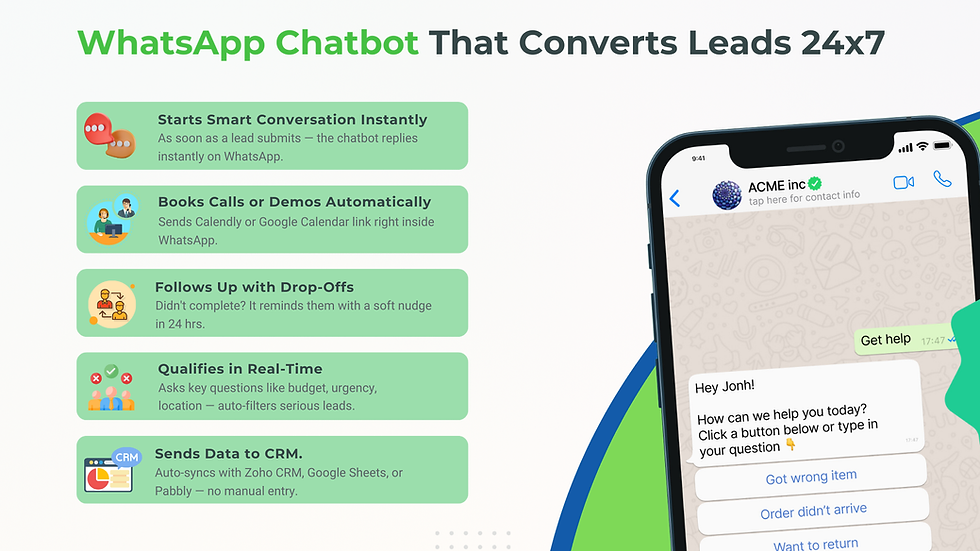
Why: Acknowledgement reduces anxiety and signals competence. What to send: A short, human message confirming receipt and the next step. Use the channel the lead used (WhatsApp, SMS, email) or the channel they prefer. Example:
Thanks, Vikash — got your request. Quick Q: demo or pricing? Tap one.
Implementation notes:
• Use templated messages for speed but keep them conversational.
• Include the lead’s name and the action they took to increase perceived relevance.
• If you can’t reply in under a minute, send a timestamped confirmation and an expected SLA (e.g., “We’ll get back within 1 hour”).
2. Micro‑qualification (1–3 questions
Why: You need to separate noise from opportunity without creating friction. Principle: Ask only what materially changes routing or prioritization. Two to four items is the sweet spot. Suggested fields: budget range, timeline, primary use case, company size. Use buttons or dropdowns where possible.
Scoring heuristic (example):
• Budget > $10k → +40
• Timeline = this month → +30
• Use case = enterprise → +20 Threshold for human review: ≥75.
3. Deterministic routing (immediate)
Why: Random or ad‑hoc routing creates latency and contention. Deterministic routing gets leads to the right human fast. How to route:
• Primary keys: geography, language, product line.
• Overlays: rep capacity, recent performance, time zone.
• Algorithm: weighted round‑robin with capacity overlays. Implementation tip: Map by API field names, not by labels. Labels change; API names don’t.
4. Tiny rule for conversion (the minimal viable follow‑up)
Why: Complexity breaks. A single, reliable rule wins more often than elaborate flows. The tiny rule: immediate confirmation to the lead + a short‑window nudge to the rep (e.g., 6 hours) if no action. Why it works: It reduces latency, preserves human agency, and is easy to test.
5. Multi‑channel follow‑up sequence (practical cadence)
Principle: Use the channel that matches intent and urgency. Mix channels to increase reach without spamming. Suggested sequence (example):
T+0s: Instant channel acknowledgement (WhatsApp/SMS/email).
T+10–60m: Micro‑qualification follow‑up (same channel).
T+6h: Rep nudge (internal task + email/SMS to lead if rep hasn’t acted).
T+24h: Soft nudge (WhatsApp/SMS) with a one‑click booking link.
T+3 days: Email with case study and CTA.
T+7 days: Final check and opt‑out option.
Channel selection rules:
• Use WhatsApp/SMS for immediacy.
• Use email for attachments, pricing, and long‑form content.
• Use phone calls for high‑value or complex leads.
6. Human‑in‑the‑loop escalation
Why: Automation should augment judgment, not replace it. When to escalate: lead score ≥ threshold, ambiguous qualification, or high‑value signals (e.g., enterprise domain, repeated visits). What to include in the handoff: transcript, answers to qualification questions, suggested next steps, and a one‑click claim button for the rep.
7. Data hygiene at capture (canonicalization at the edge)
Why: Garbage in, garbage out. Bad data creates duplicates, misrouting, and broken automations. Actions to take:
• Enforce dropdowns for categorical fields.
• Normalize company names (strip suffixes, trim whitespace).
• Validate phone and email with regex and lightweight verification.
• Store API field names and use them for mapping.
Staging: route raw payloads to a staging table (Google Sheets or a lightweight DB) for inspection before committing to CRM.
8. Deliverability and compliance
Essentials: explicit opt‑in, message templates for outbound outside the 24‑hour window, and audit trails for consent. Deliverability checklist: SPF/DKIM configured, reputable SMTP provider, throttling for high volumes, and monitoring of bounce/spam rates. Compliance: record timestamps and source of consent; respect local data laws.
9. Observability: the metrics that matter
Primary metric: first‑reply time — the single most predictive KPI for early conversion. Secondary metrics: qualification completion rate, booking rate, conversion from booked to closed, drop‑off points in the flow, duplicate rate. Operational dashboards: real‑time queue depth, webhook success rate, and anomaly alerts for spikes in duplicates or failed sends.
10. Common failure modes and mitigations
• Bad data → duplicates/misrouting: enforce canonicalization and staging.
• Over‑automation → noise: add a one‑click disable and run small cohorts.
• Deliverability issues → low reach: fix SPF/DKIM and use throttling.
• Webhook limits → silent drops: implement retries and backoff.
• Rep distrust → ignored automation: run shadow mode, involve reps early, and iterate.
11. Tools and architecture (practical stack)
Lightweight stack (small teams): form → Google Sheets staging → Zapier → WhatsApp/SMS + Calendly → Google Calendar → CRM (HubSpot/Pipedrive). Midmarket stack: form → Make (data transforms) → Twilio/WhatsApp Business API → HubSpot CRM → Calendly/Google Calendar → BI dashboard. Notes: choose tools that let you inspect raw payloads, transform data (trim, normalize), and add a kill switch.
12. Example micro‑win (realistic numbers)
A 25‑seat B2B SaaS had a 48‑hour average lead response time and 12 demos per month. After implementing: canonicalization at capture, the tiny rule (confirm + 6‑hour rep nudge), and deterministic routing, response time dropped to ~3 hours and demo bookings rose to 24 per month within six weeks. Reps reported saving 5–7 hours weekly because they stopped triaging automation failures.
13. Playbook: 30‑day implementation checklist
1. Add instant acknowledgement template and SLA.
2. Implement a 2–3 question micro‑qualifier with buttons.
3. Route raw payloads to a staging table for 7 days.
4. Build the tiny rule: confirm + 6‑hour rep nudge + one‑click disable.
5. Map fields by API name and canonicalize company and phone.
6. Instrument first‑reply time and monitor daily.
7. Run a 10% canary cohort for one week, measure, iterate.
14. Cultural change: getting reps to trust automation
Start in shadow mode: automation suggests actions but does not execute. Collect rep feedback, iterate flows, then flip to active mode. Reward reps for claiming and closing automated leads. Trust is built through predictable, reversible automation.
15. Final thought: systems beat volume
Leads are not the problem. Systems are. Fix the handoff, reduce latency, and preserve human judgment where it matters. Small, deterministic changes—canonicalization at capture, the tiny rule, deterministic routing, and a one‑click disable—compound into measurable revenue gains. Start with first‑reply time. Improve it. Then scale.
Comments